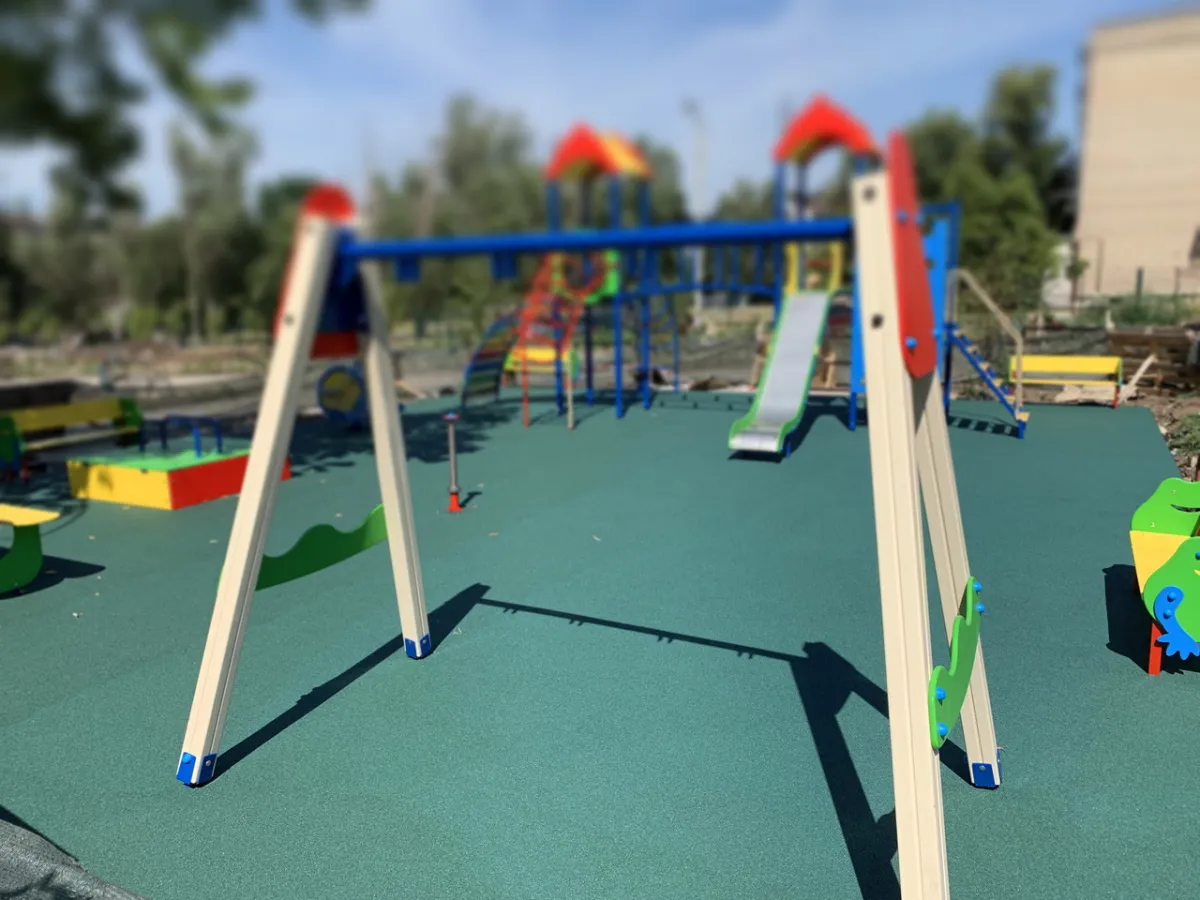
Playground Safety Surfacing: Thickness, Fall Height, Systems
Playground surfacing thickness is set by the fall height of the tallest piece of equipment on the site. Under ASTM F1292 a 2 foot fall height needs roughly 1.5 inches of poured rubber, a 5 foot fall height needs 3.25 inches, and a 10 foot fall height needs 4 inches. The CPSC Public Playground Safety Handbook adds a use zone extending a minimum of 6 feet in all directions from the equipment.
Playground surfacing has one job that outranks every other. It has to slow a falling child enough that a fall from the equipment does not become a head injury. Color, texture, drainage and service life all sit behind getting the depth right for the equipment actually on site.
What thickness a fall height needs
In the United States playground surfacing is judged against ASTM F1292, the Standard Specification for Impact Attenuation of Surface Systems Under and Around Playground Equipment. Testing produces a critical height rating, defined as the fall height below which a life-threatening head injury would not be expected to occur.
That rating has to equal or exceed the free fall height of the tallest piece of equipment, meaning the highest point a child can stand, sit or hang from. The same number sets the minimum depth beneath the equipment and across the use zone around it.
| Fall height | Minimum poured thickness | Suitable build |
|---|---|---|
| Up to 2 feet | 1.5 inches | Any single layer or 2-layer system |
| Up to 3.5 feet | 2.5 inches | Single layer SBR or 2-layer SBR and EPDM |
| Up to 5 feet | 3.25 inches | 2-layer SBR and EPDM |
| Up to 10 feet | 4 inches | 2-layer SBR and EPDM |
Treat that table as a planning guide rather than a specification. The exact depth comes from the manufacturer ASTM F1292 test data for the specific system being installed, because the critical height rating belongs to the tested assembly and not to the granule inside it.
Depth follows the tallest element, never the average. A 5 foot platform in the corner of an otherwise low playground sets the requirement for its own use zone, and the CPSC Public Playground Safety Handbook puts that zone at a minimum of 6 feet in all directions from the equipment.
Poured surface or rubber tile
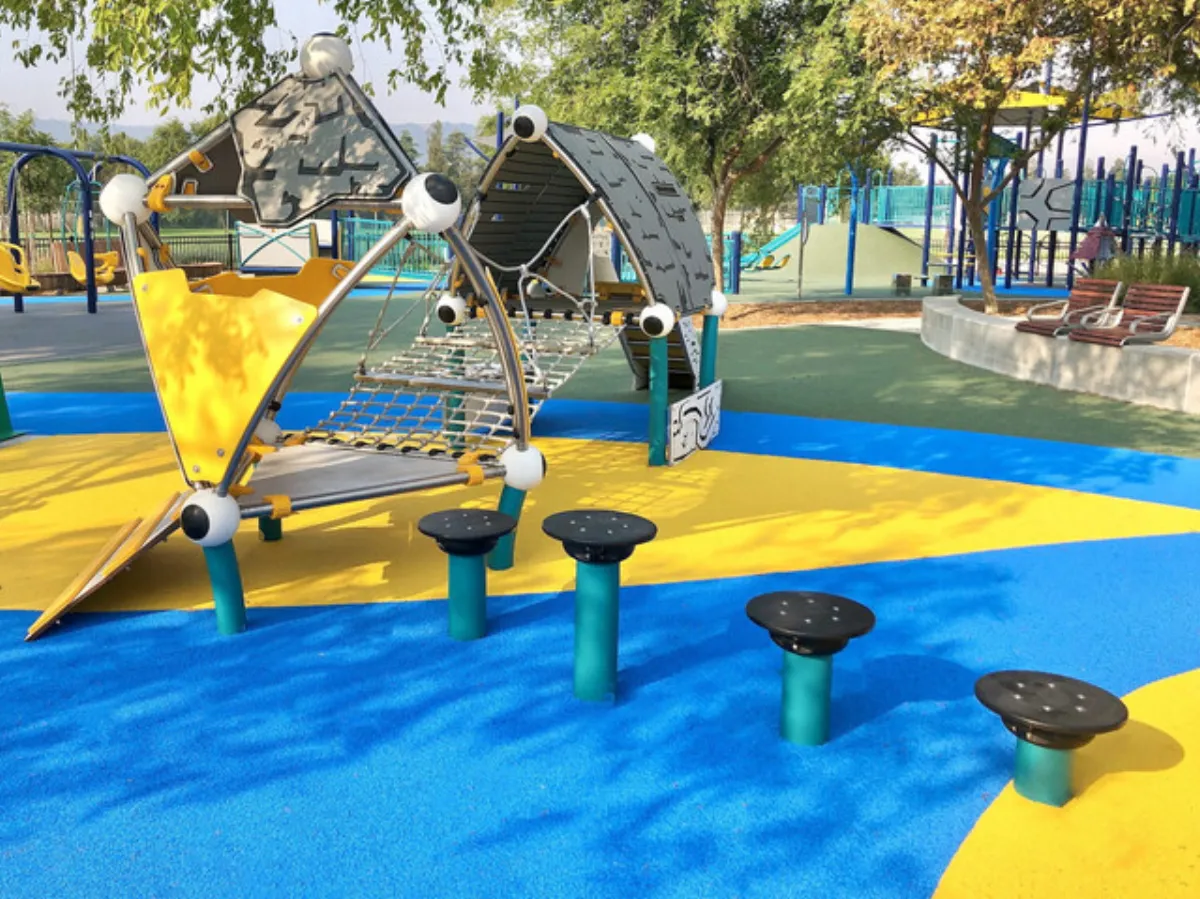
Both routes reach the same critical height rating. They differ in how they are installed and in how they behave over the 10 years that follow.
Seamless poured surface
- Monolithic, so there are no joints to lift, curl or collect grit along the edges.
- Follows any shape and wraps tight around posts, footings and curved borders.
- Takes multi color inlays such as play zones, graphics, hopscotch grids and use zone markings.
- Built 1.5 to 4 inches deep to suit the fall height on site.
- Needs a prepared solid base and dry weather during the pour.
20 by 20 inch rubber tiles
- Modular and pre-cured, so installation is fast and does not depend on cure conditions.
- Tiles from 1.2 inches thick can be laid on a compacted gravel and sand base without a concrete slab.
- Can be lifted and relocated, which suits leased sites and temporary layouts.
- Has joints that collect grit, and units can shift if the base settles under them.
For a permanent new playground the poured system is the usual specification. Tiles make sense where the base is damp or unprepared, or where the installation may have to move. ASTM F1951 applies to either build wherever an accessible route crosses the surface, since it measures the effort needed to push a wheelchair across it.
Which system builds are available
| Build | Composition | Thickness | Notes |
|---|---|---|---|
| Single layer black SBR | Black SBR granule | from 0.4 inch | The economy build. Paths and low equipment where color is not a factor. |
| Single layer pigmented SBR | SBR granule with color pigment | from 0.4 inch | Color at the lowest cost. Pigment coats the granule, so it fades faster than EPDM. |
| Single layer colored SBR | Colored SBR granule | from 0.4 inch | Colored throughout the layer, a mid range option. |
| Mixed single layer | SBR with EPDM broadcast into the surface | from 0.4 inch | A combined finish that buys part of the EPDM look for less money. |
| Full EPDM | EPDM granule throughout | from 0.4 inch | Brightest and most UV stable. Color runs full depth, so wear does not show through. |
| 2-layer, called 2S | SBR base with a colored EPDM wear layer | 0.75 to 4 inches | The playground standard. Reaches any critical height in the table above. |
| Rubber tile | Pre-cured SBR with an optional colored face | from 1.2 inches | 20 by 20 inch modules. Removable and relocatable. |
Only the last 2 rows are normally specified under equipment with real fall height. The thin single layer builds belong on paths, borders and transition areas where impact attenuation is not the governing requirement.
How the 2-layer system works
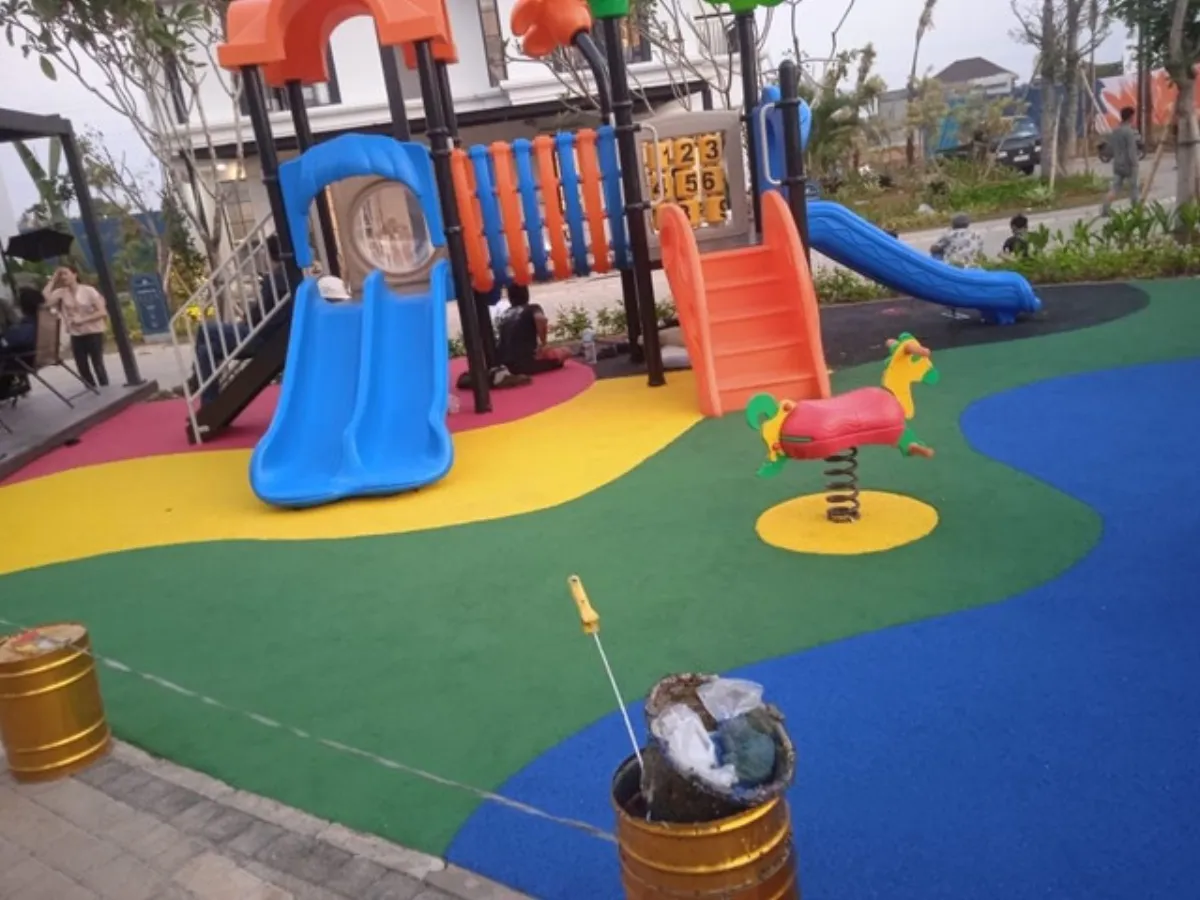
A 2-layer build separates the 2 jobs the surface has to do. The lower SBR layer carries almost all of the depth and does the shock absorption, so it is the part sized against the fall height table.
The upper EPDM layer is thin, typically 0.4 inch, and does the visible work of color, UV stability and wear resistance. Because the expensive granule sits only in the cap, a 4 inch protective depth costs far less than the same depth poured in EPDM throughout.
The wear layer goes down while the base layer is still green, so the 2 layers knit into a single body rather than sitting as separate sheets that can delaminate later.
Neither granule passes or fails on its own. ASTM F1292 rates the assembled system at its installed depth, which is why a change in base preparation or binder ratio can move the result even when the material list stays the same.
What the surface does beyond impact
- Water permeable. Rain drains through the granule matrix instead of standing on top. After a South Florida downpour the playground is usable again within minutes rather than being closed for the rest of the afternoon.
- UV stable color. EPDM granule is colored through its whole body and holds its shade under year round sun. Pigmented SBR costs less but lightens faster.
- Design freedom. Multi color pours allow zone divisions, graphics, numbers and markings poured in rather than painted on, so they wear at the same rate as the surface around them.
- Repairable. A worn or damaged patch is cut out and re-poured, and the new material bonds to the old, so there is no visible seam to manage afterwards.
- Coastal and pool exposure. The cured polyurethane matrix is unaffected by salt air and chlorinated splash out, which matters where the play area sits beside a pool deck.
- Low maintenance. Clear leaves and debris, then rinse the surface down periodically. Nothing needs sealing, sanding or topping up.
Where these systems are used
The same build appears across most South Florida site types, sized to whatever fall height the equipment creates.
- Public and community playgrounds
- HOA and condominium play areas
- School and daycare yards
- Sports courts and outdoor workout zones
- Walkways and pool surrounds
- Splash pads and shaded play areas
How the installation runs
- Survey. Fall heights measured, use zones mapped, base condition and slopes checked.
- Base preparation. Grinding, patching and cleaning on concrete or asphalt, compaction and grading on a gravel base.
- Priming. Polyurethane primer over concrete and asphalt, mandatory, and the main defense against delamination.
- Base layer. SBR mixed by weight and screeded to the depth the ASTM F1292 rating requires.
- Wear layer. Colored EPDM laid over the still green base, with inlays and markings cut and poured at this stage.
- Cure and handover. Foot traffic after about 24 hours, full cure in 2 to 3 days depending on humidity.
A playground of up to roughly 1,600 square feet is normally a 2 to 3 day installation. Larger sites are poured in sections so that each pour stays inside the working time of the binder.
Common questions on playground surfacing
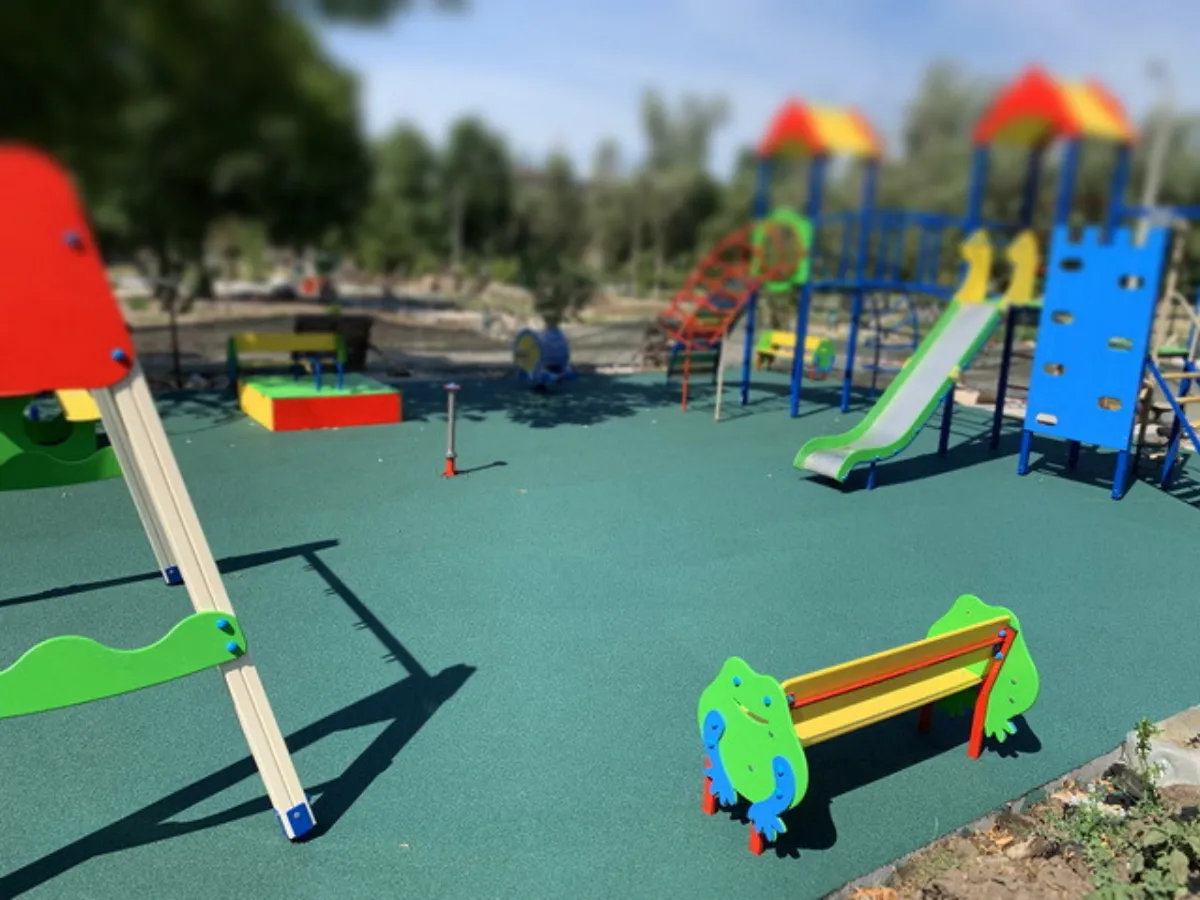
What thickness a playground needs
It depends on the free fall height of the tallest equipment. As a planning guide, 2 feet of fall height needs 1.5 inches, 3.5 feet needs 2.5 inches, 5 feet needs 3.25 inches and 10 feet needs 4 inches. The final depth comes from the ASTM F1292 test data for the system being installed.
Choosing between a poured surface and tiles
A poured surface is monolithic, has no joints, follows any shape and gives dirt nowhere to collect. Tiles are modular, install faster, and can be lifted and relocated, and tiles from 1.2 inches thick can go on a gravel base without concrete. For a permanent new playground the poured system is the usual choice.
SBR or EPDM for a playground
SBR is recycled tire granule, black or pigmented, and considerably cheaper. EPDM is a manufactured synthetic granule colored through its body that holds color under UV for years. The usual answer is both, with an SBR base for the protective depth and a 0.4 inch EPDM wear layer on top.
What base the surface needs
A poured surface goes over any sound hard base, including concrete, asphalt, metal and timber. Priming is mandatory on concrete and asphalt. Tiles under 1.2 inches also require a hard base, while tiles of 1.2 inches and thicker can be laid on a compacted gravel and sand base without a slab.
Whether the surface is safe for children
SBR is recycled tire rubber that has been cleaned and degassed during processing, and EPDM is a synthetic rubber granule. The cured surface holds no free solvents and is inert once the binder has fully reacted. Manufacturer material documentation is available for every system installed.
Graphics, numbers and zone colors
Any EPDM based build supports multi color work such as play zones, graphics, hopscotch grids and marked use zones. Because the color is poured in rather than painted on, it wears at the same rate as the surrounding surface. The layout is agreed before installation starts.
How long the surface lasts
10 to 15 years with correct installation. Keep leaves and debris cleared and rinse the surface periodically, since there is nothing to reseal or top up. UV exposure is the main aging factor in Florida, which is why an EPDM wear layer is worth the difference on any surface in full sun.
Repairing a damaged area
A worn or damaged patch is cut out and re-poured, and the new material bonds chemically to the existing surface. There is no seam to match and no unit to source, which is a clear advantage over tile or asphalt.
How it drains in heavy rain
The surface is porous, so rain passes straight through into the base instead of pooling on top. On a gravel base a 1 to 2 percent fall is built in so the water that comes through has somewhere to go, and on concrete the slab slope handles it. That is what lets a playground reopen minutes after a storm.