Sports Court Surface Systems Explained
A poured rubber sports court is rubber granule blended with polyurethane binder and placed over a primed base, where it cures into 1 seamless sheet with no joints. Playing surfaces are normally built 0.6 to 0.8 inches thick, pedestrian surrounds 0.4 to 0.6 inches, and free weight zones 0.8 inches and above. The surface stays porous so rain drains straight through, and a correctly installed court lasts 7 to 15 years in South Florida conditions.
A sports court surface has to do 3 things at once. It has to give the ball a predictable response, give the player grip and some give underfoot, and survive years of sun, rain and hard use without breaking up. Poured-in-place rubber does all 3, and because it is mixed on site it can be tuned by thickness, granule type and layer count to the sport actually being played on it.
How a rubber court is built
Rubber granule, either SBR, EPDM or a combination, is blended with a 1-component polyurethane binder, spread over a primed base and compacted to a set thickness. It cures into one seamless sheet with no joints to open up and no tiles to lift. The surface stays porous, so rain drains through instead of ponding on the playing area.
Systems are described by the number of layers laid. A 1S build is a single homogeneous layer. A 2S build is an SBR base that carries the thickness, capped with a thin colored EPDM wear layer.
Because the mix is proportioned on site, a single court can carry different depths in different zones. A basketball key that sees the heaviest landings can be built deeper than the surround without a joint between the 2 areas.
What thickness a court needs
| Use | Thickness | Notes |
|---|---|---|
| Pedestrian areas and surrounds | 0.4 to 0.6 inches | Comfort and grip rather than performance |
| Basketball, volleyball, tennis, pickleball | 0.6 to 0.8 inches | Predictable ball response with joint relief |
| Workout and free-weight zones | 0.8 inches and up | Absorbs dropped weights and machine loads |
| Running tracks | 0.4 to 0.5 inches | SBR base with a sprayed or poured polyurethane finish, machine-laid |
There is no single national depth to design to. Athletic surfaces are specified against the governing body spec for the sport together with the manufacturer tested shock absorption and ball rebound values for that exact system, which is why a school volleyball court and a free weight platform do not share a number. Ask any bidder for the test data behind the depth they propose.
Fall height is a separate matter. Where a rubber surface sits under play equipment, it is judged against ASTM F1292 critical height rather than against any sports specification, and the rating must equal or exceed the fall height of the tallest structure on site.
How the build options compare
| Build | Composition | Layers | Color | Suited to |
|---|---|---|---|---|
| Black SBR | SBR | 1S | Black | Practice areas, service zones and parking aprons where color is irrelevant |
| Pigmented SBR | SBR with pigment | 1S | Colored | The budget color option, though pigment fades faster than EPDM |
| SBR with colored finish | SBR under a colored top | 1S | Colored | Balanced price and durability for a club or school court |
| Versatile SBR or EPDM | SBR or EPDM | 1S | Colored | General-purpose courts for basketball, volleyball and tennis |
| Track system | SBR base under a polyurethane finish | 2S | Colored | Running tracks, high resilience, spray-applied finish |
| Full EPDM | EPDM throughout | 1S | Bright | Courts in full sun, since color runs full depth and does not fade |
| 2-layer premium | SBR base under an EPDM wear layer | 2S | Bright | The highest wear resistance and shock absorption in the range |
Cost rises roughly in the order shown. The jump from pigmented SBR to a 2-layer EPDM build typically doubles the material line while adding 5 or more years of color life, so the decision is usually about how visible the court is rather than about performance.
Which sports it suits
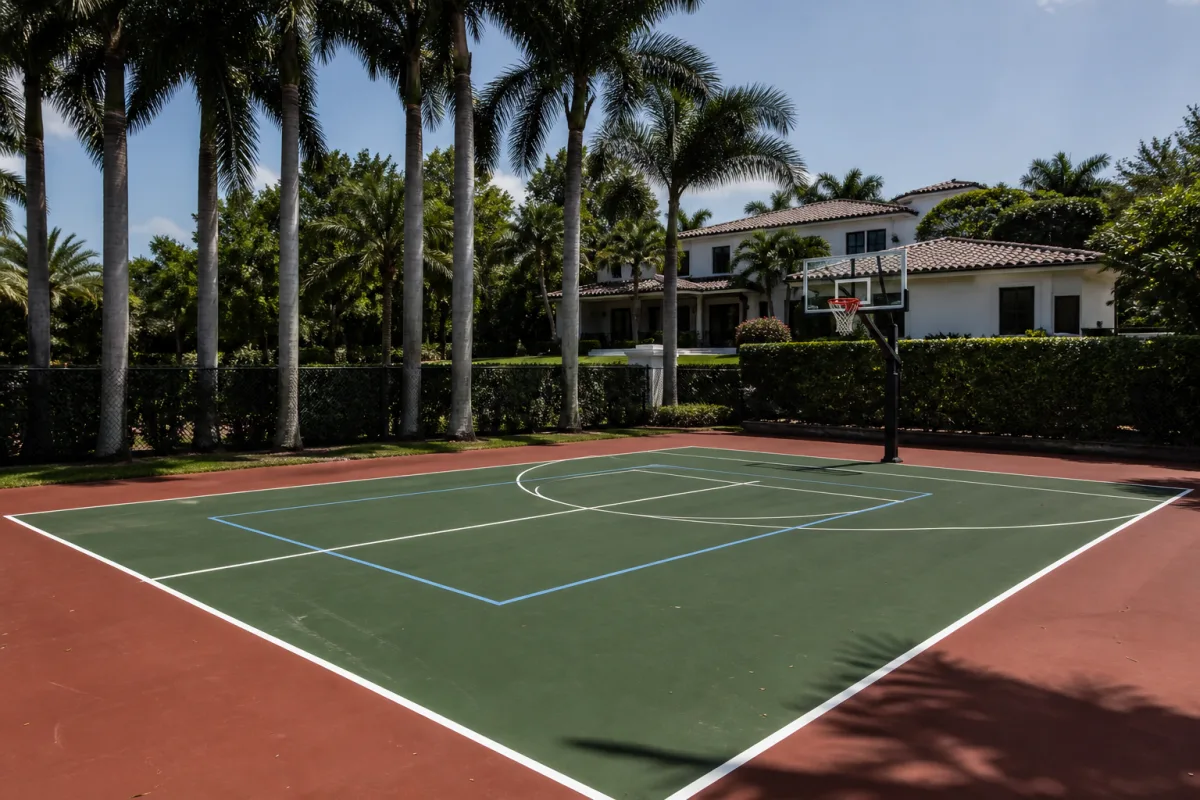
- Basketball. 0.6 to 0.8 inches with poured line markings, resilient enough to take load off knees and ankles.
- Volleyball. Zone colors poured in, with a non-slip texture for lateral movement and dives.
- Tennis and pickleball. A level, uniformly compacted surface for a predictable bounce.
- Workout and CrossFit zones. Thicker builds that take dropped bars and machine footings.
- Multi-sport courts. Several sets of markings in different colors on one field.
- School and HOA courts. School yards, condominium grounds and community recreation areas.
A single pad can carry 3 or 4 sets of lines without any change to the build. Only the thickness has to be settled before the pour, since markings are added after the surface cures.
Why the surface holds up in Florida
- UV stability. EPDM granule is colored through its body, so court colors and markings hold their shade under year-round sun instead of chalking out. Pigmented SBR costs less but lightens faster.
- Drainage. The porous matrix lets a downpour pass straight through into the base. Play resumes shortly after the rain stops rather than waiting for a slab to dry.
- Wet grip. The granule texture stays non-slip when damp, which matters on outdoor courts through the wet season.
- Chlorine and salt air. Cured polyurethane is unaffected by pool splash-out and coastal exposure, so a court beside a pool deck is not a special case.
- Heat and movement. The surface is elastic enough to move with a slab that expands in the heat without cracking or debonding, provided the base was primed correctly.
What base the surface needs
The surface goes over any solid base, whether concrete, asphalt, or a compacted crushed-stone base with a binder layer. Concrete and asphalt are primed before application, and priming is what keeps the rubber bonded when the slab heats up and moves.
The base has to be level to within about 0.125 inch over 3 feet, clean and dry. Fresh asphalt should be at least 10 days old before it is surfaced, and new concrete needs 28 days plus a moisture reading. Falls are corrected at the base stage, not by varying the depth of the rubber.
What the surface is made of
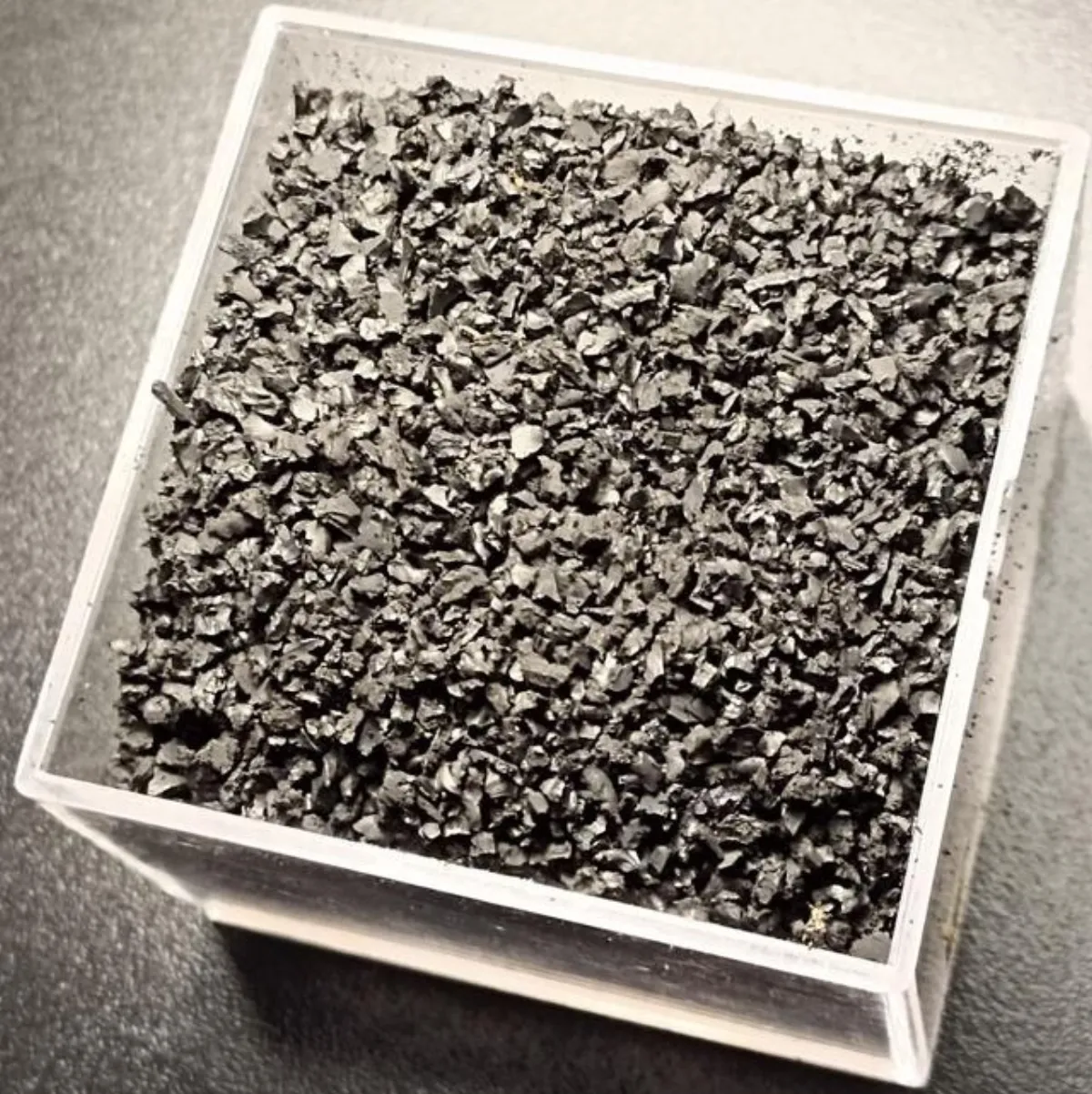
- SBR granule. Black recycled tire rubber for base layers and single-layer builds.
- Colored EPDM granule. Manufactured synthetic granule, UV-stable and colored throughout.
- Polyurethane binder. 1-component and moisture-cured, with aliphatic grades on exposed top layers so they do not yellow.
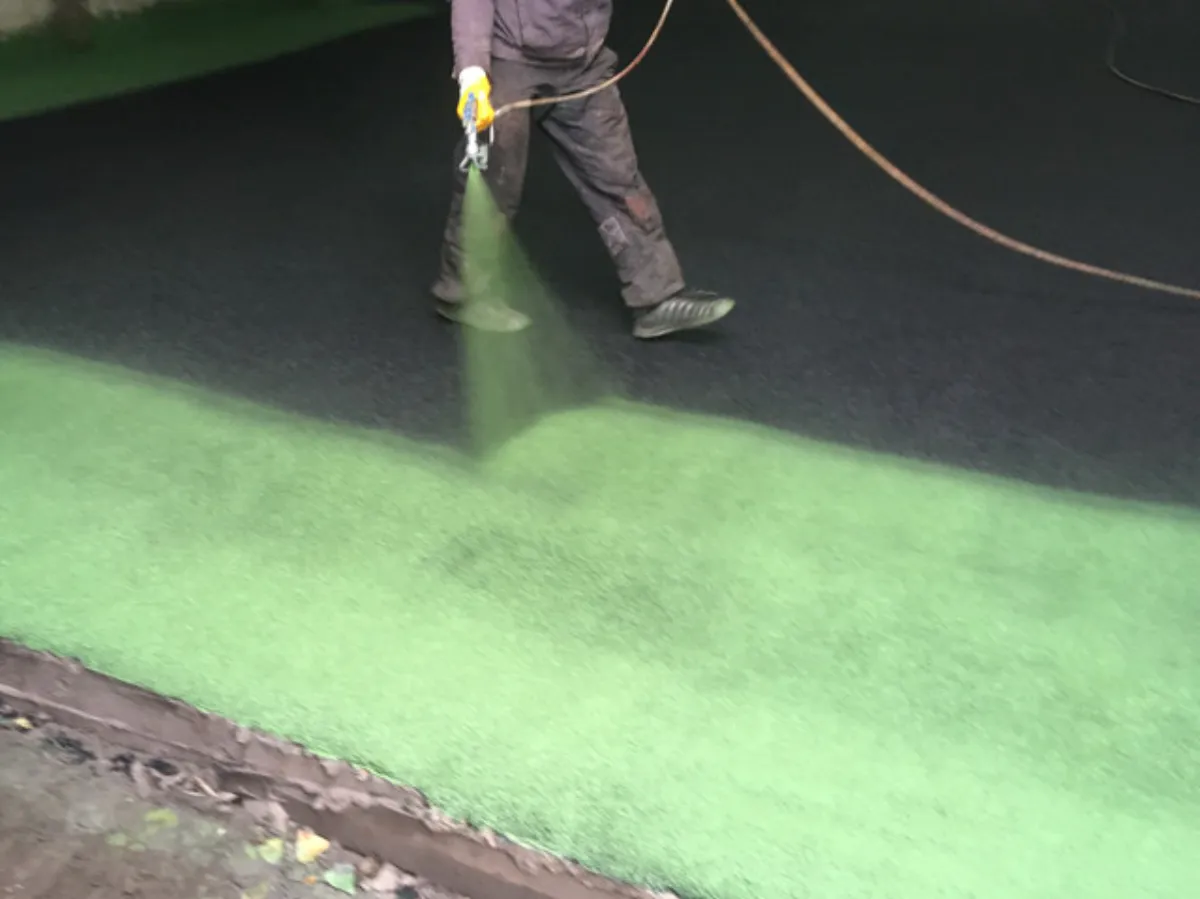
- Polyurethane line paint. Applied for markings once the surface has cured.
Granule size is part of the specification as well. Base layers normally use a coarser 0.08 to 0.2 inch granule for bulk and drainage, while wear layers use a finer grade so the finished texture is tight enough for ball contact.
How a court is installed
- Base preparation. Grinding or patching, dust removal, and correction of falls where water needs to move off the court.
- Priming. Polyurethane primer on concrete and asphalt, left to tack off.
- Mixing. Granule and binder proportioned by weight in a forced-action mixer. The binder ratio sets the strength of the finished surface and is the most common thing to get wrong.
- Placing. The mix is screeded to depth and compacted by trowel, or by paving machine on tracks and large courts.
- Wear layer. On 2-layer builds the colored EPDM goes on while the base is still green, so the layers knit together instead of stacking.
- Markings. Lines are set out and applied in polyurethane paint once the surface has cured.
A standard court runs 3 to 5 working days on site, with most of that time spent on base preparation rather than on the pour itself.
Common questions on sports courts
What a rubber granule surface is
A seamless, poured-in-place surface made from rubber granule, either SBR or EPDM, and a 1-component polyurethane binder. It is mixed and placed on site and cures into a single continuous sheet with no joints.
What thickness a sports court needs
Pedestrian areas 0.4 to 0.6 inches. Courts 0.6 to 0.8 inches. Workout zones with heavy free weights 0.8 inches and above. Running tracks 0.4 to 0.5 inches with a specialist finish. The final depth follows the governing body spec for the sport and the manufacturer test data for the system being installed.
How the different builds compare
Black SBR is the most economical single-layer option. Pigmented SBR adds color at low cost but fades sooner. SBR with a colored finish is the usual balance of price and durability. A versatile SBR or EPDM single layer suits most courts. Full EPDM is colored throughout and holds its shade in full sun. 2-layer builds give the highest wear resistance and shock absorption.
Whether the surface is safe to play on
It absorbs impact and reduces load on joints compared with concrete or asphalt. The binder contains no organic solvents once cured. SBR is recycled tire rubber that has been degassed during processing, and EPDM is a manufactured synthetic rubber. Manufacturer material documentation and shock absorption test data are supplied for any system installed. Where the surface also sits under play equipment, ASTM F1292 critical height applies.
What base it is laid on
Concrete, asphalt, or a compacted crushed-stone base with a binder layer. Concrete and asphalt are primed first. The base must be level to about 0.125 inch over 3 feet, clean and dry, and fresh asphalt needs at least 10 days before surfacing.
How long a court surface lasts
7 to 15 years, depending on material grade, intensity of use and how closely the installation followed the procedure. EPDM and 2-layer builds sit at the top of that range and a basic black SBR court at the bottom.
Choosing colors and line markings
Any pigmented, colored-finish or EPDM build takes color, and EPDM gives the brightest and most durable result. Markings for basketball, volleyball, tennis and pickleball are applied in polyurethane paint after the surface has cured, and 3 or 4 sets of lines in different colors can share one court.
What conditions installation needs
A surface temperature of at least 50 degrees F, a dry base and no rain forecast for the first 24 hours. Because the binder cures with atmospheric moisture, high humidity shortens working time, so work is scheduled around the daily rain pattern rather than around the season.
How the surface is maintained
Clear leaves and debris, and pressure wash on a wide fan tip as needed. Line markings are refreshed every few seasons on heavily used courts. Nothing needs painting, sanding or sealing.
Whether a worn area can be repaired
Yes. A damaged section is cut out and re-poured, and the new material bonds chemically to the surrounding surface, so there is no seam to match and no units to source.